Sunday 21 / June / 2026
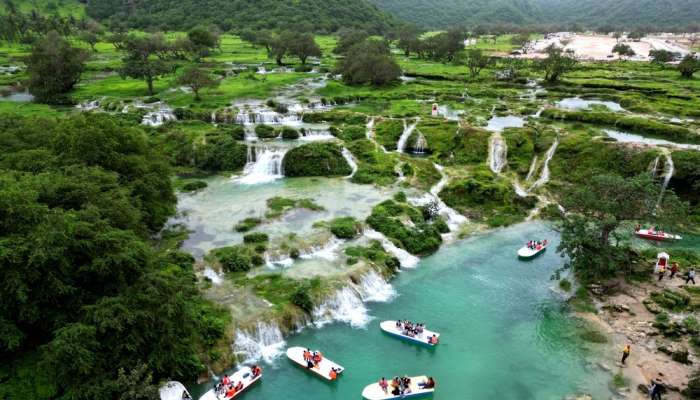
Salalah: As Khareef Dhofar “Monsoon season” begins, a new report has recorded above‑average rainfall for the season of 2025, with positive water indicators across Dhofar Governorate, including enhanced groundwater recharge, increased spring flows and improved water collection in surface storage dams.
The annual Khareef season report, issued by the Directorate General of Agriculture, Fisheries and Water Resources in Dhofar Governorate, showed that most monitoring stations recorded rainfall exceeding seasonal averages by 11 to 91 percent, with the Kanzir station in Salalah recording the highest total of 731.6 mm.
Eng. Ali bin Bakheet Beit Said, Director of the Water Resources Department, said the low pressure system that affected Dhofar from 15 to 25 August 2025 boosted rainfall totals, activated wadi flows and waterfalls, and enhanced groundwater recharge.
He added that hydrological analysis showed a positive response from groundwater reservoirs, with rising water levels and increased spring flows following peak rainfall in July and August.
He explained that total flow from the governorate’s main springs reached about 13.4 million cubic metres during the season, while the average flow of the Razat spring recorded 322 litres per second, exceeding its ten‑year average.
He said that surface dam storage also increased, with total stored water reaching 13,953 cubic metres compared to 11,177 cubic metres in the 2024 season, improving water storage efficiency and the use of surface runoff.
He affirmed that the Khareef season’s importance extends beyond rainfall totals to its role in sustaining groundwater recharge and spring flows, which are vital to water security and environmental development in Dhofar Governorate.
He explained that the report was based on data from the governorate’s hydrological monitoring network, which tracks rainfall distribution and the response of groundwater and springs to climatic variables, supporting informed water resource management decisions.
He concluded that the Ministry of Agriculture, Fisheries and Water Resources continues to develop the monitoring system, expand databases, enhance scientific studies on water resources, and improve water harvesting facilities to support integrated water management, adapt to climate change, and advance water security and sustainability targets.
The Khareef Dhofar season is one of Oman’s most significant climatic phenomena, supporting water resources, vegetation cover and ecosystem sustainability through drizzle, low clouds and fog that recharge groundwater, sustain spring flows and activate wadis and waterfalls.