Thursday 11 / June / 2026
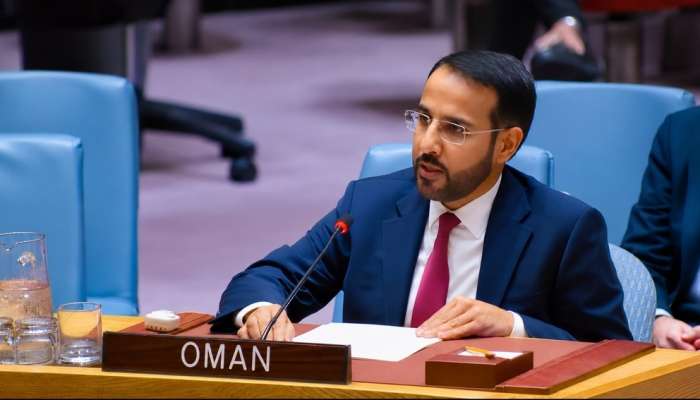
New York --- The Sultanate of Oman has said that achieving sustainable security and stability in the Middle East region is heavily dependent on addressing the causes of conflicts.
In a speech before the UN Security Council meeting in New York yesterday (10 June 2026), Oman pointed out that “Political solutions remain the most trustworthy path to the consolidation of peace and the initiation of prospects for development and stability for the peoples of the region.”
Oman’s speech before the Security Council was delivered by Khalid Saleh Al Rabkhi, Deputy Permanent Representative of the Sultanate of Oman to the United Nations.
Al Rabkhi underscored Oman’s view during a high-level UN open debate themed “Promoting Political Solutions in the Middle East: Mediation and Dialogue for Lasting Peace”. The Security Council meeting was chaired by Colombian President Gustavo Petro Urrego.
He said that experiences in the Middle East region proved that crises that were not addressed at their very roots re-surfaced in different forms, and that conflicts that lacked fair settlement continued to impact the region’s security and stability.
Al Rabkhi observed that the value of political solutions lies in their ability to address the fundamental causes and to establish appropriate conditions for achieving lasting peace.
He added that the success of mediation and peaceful settlement of disputes depends on a number of factors, including building confidence between the disputing parties, respecting the sovereignty of countries, adhering to international law and providing grounds for dialogue and understanding.
Al Rabkhi noted that, in terms of factors affecting the security and stability of the Middle East, the Palestinian cause remains the most prominent hurdle and the most frequently discussed issue. He added that “The Palestinian people are still waiting for the principles that were adopted by the international community to be converted into tangible reality that guarantees their legitimate rights.”
He explained that negative developments in the occupied Palestinian territories over recent decades affirmed the heavy human toll and the serious political consequences that were the direct outcome of absence of a political settlement.
Al Rabkhi reiterated the Sultanate of Oman’s focus on the fact that “Achieving a just and lasting peace requires ending the Israeli occupation of Palestinian lands and enabling the Palestinian people to exercise their right to self-determination and establishment of their independent state based on the borders of 4 June 1967, with Al Quds A’Sharqiyah (East Jerusalem) as its capital—in accordance with resolutions of international legitimacy and the Arab Peace Initiative.”
He stressed that the Middle East region needs to develop a collective conviction that peace is a strategic choice, and that addressing the causes of conflicts constitutes an investment in the security of peoples and opens vistas for achieving the stability of countries and securing the future of upcoming generations.
Al Rabkhi laid emphasis on the need to provide constant support for mediation efforts, preventive diplomacy and the integration of international and regional initiatives in a manner that contributes to building trust and establishing conditions for sustainable political solutions.
He reiterated that—based on its approach of wisdom, moderation, mutual respect and good neighbourliness, Oman will continue to back all efforts aimed at the rapprochement of views and the consolidation of understanding, peace and stability.