Friday 10 / April / 2026
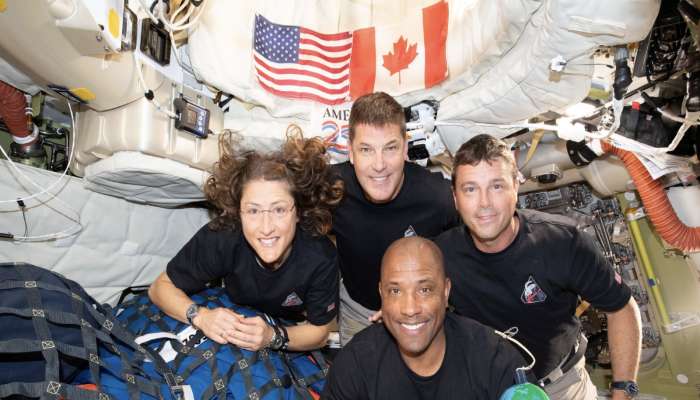
Washington DC: The Artemis II crew is in the final hours of their journey to Earth and is currently preparing for splashdown in the Pacific Ocean, following a historic lunar flyby.
The crew broke the record for the farthest human spaceflight at 252,756 miles (406,771 km) from Earth while navigating the far side of the Moon.
The historic space mission Artemis II has hit its halfway mark between the Moon and the Earth, NASA said on Thursday. According to the space agency, the astronauts would splash down in the Pacific Ocean off the coast of San Diego on April 10, Eastern Time.
Sharing the details in a post on X, NASA said, "They're halfway home. The Artemis II astronauts have hit the "halfway" mark between the Moon and the Earth. They will splash down in the Pacific Ocean around 8:07 pm ET on Friday, April 10 (0007 UTC on Saturday, April 11), off the coast of San Diego."
During the mission, the crew also saw a solar eclipse from space.
After their splashdown, US Navy's USS John P. Murtha (LPD 26) would retrieve the crew and Orion spacecraft, as per the US Indo Pacific Command.
Meanwhile, Senator Ted Cruz hailed the accomplishment of the astronauts and said that they inspired a whole new generation of space explorers.
The Artemis II mission marks a key step in NASA's plans to return humans to the Moon and advance future deep space exploration.
The crew includes NASA astronauts Reid Wiseman, Victor Glover, and Christina Koch, along with Canadian Space Agency astronaut Jeremy Hansen.
The Artemis II mission has broken the record for the farthest distance travelled by humans from Earth, breaking the Apollo 13 mission's record of 248,655 miles.
Artemis II is NASA's first crewed test flight in the Artemis campaign.
As per the official website of NASA, there are five main priorities for Artemis II. These included the ability of systems and teams to sustain the flight crew in the flight environment, and through their return to Earth; demonstrate systems and operations essential to a crewed lunar campaign; retrieve flight hardware and data, assessing performance for future missions; demonstrate emergency system capabilities and validate associated operations to the extent practical, such as abort operations and rescue procedures, as needed and complete additional objectives to verify subsystems and validate data.
Earlier this week, US President Donald Trump spoke to the crew members after the mission broke the farthest distance record in human spaceflight.
He praised them for inspiring the world with their feat. Noting that they made history, the US President said that the mission paves the way for America's return to the lunar surface. Trump also said that the US would eventually establish a permanent presence on the moon and then aim at Mars.
Artemis II marks the first crewed mission around the moon in more than 50 years, carrying four astronauts farther into space than any humans have travelled in history. (ANI)